Interpretation and reliability of SLOPE/W results


Hello everyone,
I'm carrying out a slope stability assessment in SLOPE/W for both drained and undrained conditions.
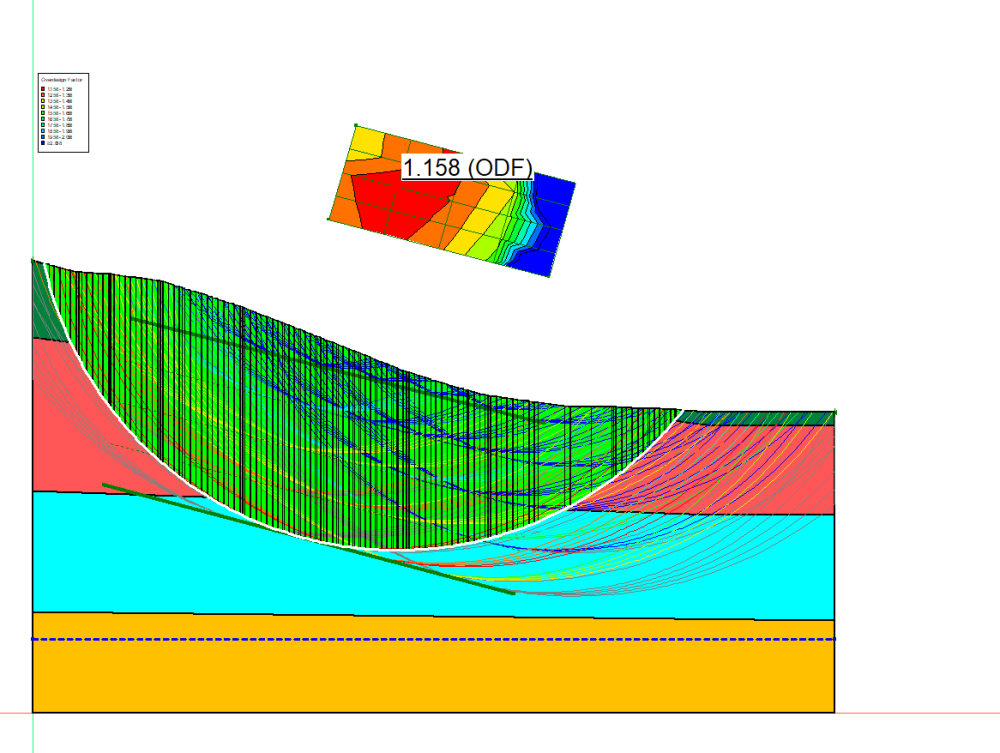
In the undrained analysis, I obtain relatively deep-seated slip surfaces involving several soil layers, with an FS of approximately 1.158.
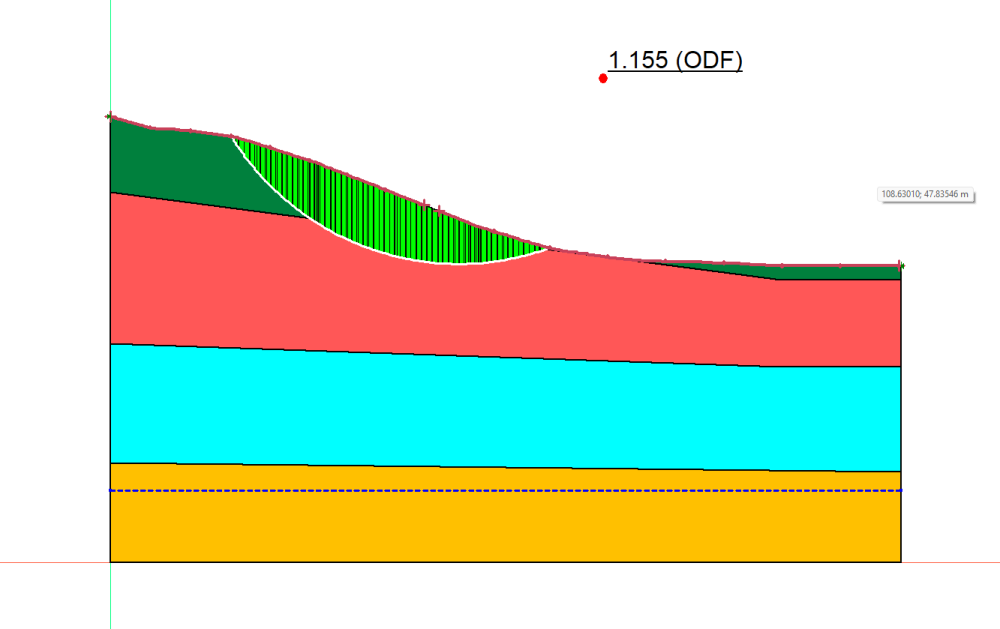
However, in the drained analysis, the critical slip surface is much shallower, with a similar FS of approximately 1.155.
I also tried modifying the soil strength parameters, but the results did not change significantly.
I would appreciate your advice on the following:
- Why are the potential slip surfaces significantly deeper in undrained conditions, even after changing the soil parameters ?
- Does such a deep-seated failure mechanism indicate a greater risk, even with FS > 1?
- Are these results realistic and acceptable, or could there be an issue with the model setup?
I've attached screenshots of both analyses for reference.
Thank you for your help!
Best Answer
-
Hi @HaniyehKarimijafarbi, I've attached a zip file that contains a GeoStudio example file and a PDF writeup that discusses this phenomenon. I hope this helps. Please let me know if you have any other questions.
0


Answers
-
Thank you for sharing that example! I’ve read it, and from what I understood, a calculated critical slip surface does not necessarily represent a realistic failure mechanism. It also suggests that effective-stress parameters (c′ and φ′), combined with realistic pore-water pressures, generally provide the best indication of the critical slip surface location.
In our case, even when I increased the undrained shear strength parameters while keeping the pore-water pressure line unchanged, the depth of the critical slip surface did not change significantly.
Interestingly, when I modified the slope geometry to make it steeper, the critical slip surface became much shallower, involving only the first two soil layers.
Is this behaviour expected in SLOPE/W? Could the slope geometry have a greater influence on the critical slip surface location than the shear strength parameters in this case?
I would appreciate your thoughts on this. Thank you again!
1
Categories
- All Categories
- 302 Community
- 3 Get Started
- 17 Latest Releases
- 16 Member Spotlight
- 42 Learning
- 1.1K Products
- 566 Geology
- 539 Leapfrog
- 1 Volsung
- 26 Visible Geology
- 36 Data Management & Collaboration
- 14 MX Deposit
- 13 Central
- 9 Imago
- 137 Geotechnical
- 137 GeoStudio
- 332 Geophysics
- 321 Oasis montaj
- 1 Workbench
- SPIA
- 10 Res2DInv & Res3DInv
- 3 Evo
- 27 GX Developer