
Mastery Session three recording ready | Advanced structural analysis in Oasis montaj

Catch up on last week's Oasis montaj Mastery session! It's now available on demand here: https://attendee.gotowebinar.com/recording/4551031915592047962
In this session, @BeckyBodger2 walked through how to leverage semi-automated workflows and advanced 3D analysis tools to interpret structural data with greater speed and confidence.
Have a question for Becky after watching the session? Post them below 👇️
Comments
-
Hi @BeckyBodger2,
Thank you very much for the Mastery Session. Unfortunately, due to the time zone difference, I wasn't able to attend live, but I've been watching the recording and I have a couple of questions.
Are there other ways to measure the dip besides visual interpretation?
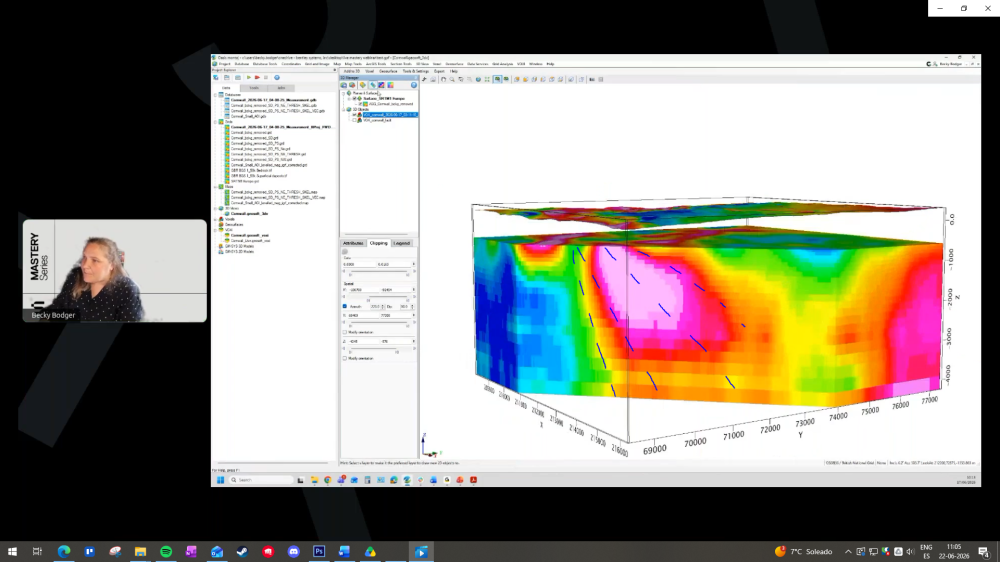
How reliable is the dip measurement from voxels? I'm asking because, in the example shown, it seems possible to interpret the same structure with different dip values depending on the chosen geophysical contrast (see attached screenshot).I also wanted to ask whether there is a trial license available for Oasis Montaj that could be used to follow along with the Mastery Sessions. I work as a structural-economic geologist, and I think it would be very valuable to gain some hands-on experience with geophysical softwares (relatively simple taks), besides just interpreting the 2D and 3D delivered by the geophysist.
Thank you for your time and support.
Best regards,
Nicolás
 1
1 -
Hi Nrodriguezoria,
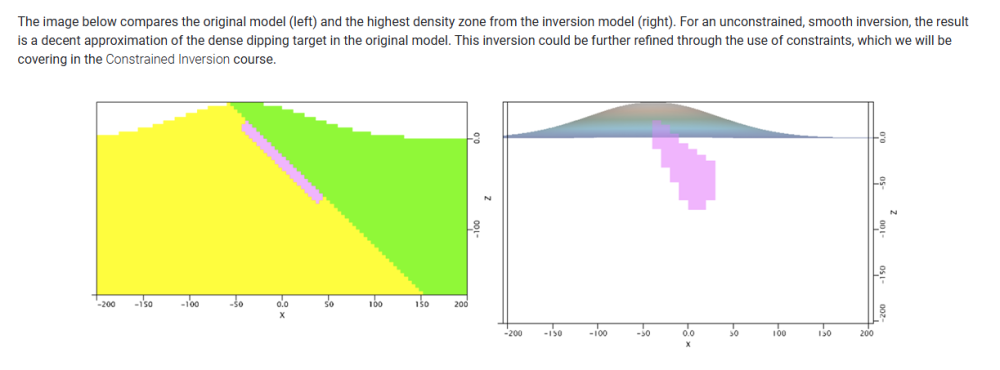
The measurement itself is accurate, I mean you will get the exact orientation of the plane itself. I know that's not what you are asking though and yes, the angle can be interpreted at many different angles. The solution is to go back to the inversion and keep refining it and adding constraints to refine the shape and sharpness of the object you are modelling. This is a really typical response from an unconstrained inversion, here's a screenshot for example from the Inversion course in our Learning platform:
We ran a bit short on time, and the following step I was going to demonstrate was how to add a fault to the inversion through a gradient reference model. Then you would see how you can start to refine the model and gain more confidence in how you interpret it.
Luckily, we will have a separate Mastery Series Webinar on 3D modelling, and my colleague Josh will hopefully demonstrate how to add constraints to the VOXI inversion. So stay tuned for that session :) In the meantime, we have additional learning content online here for improving your inversions with constraints: https://lms.seequentlearning.com/enrollments/229893116/page/883107546.I hope that helps!
2 -
Thank you very much for the explanation! It was very helpful.
I'll definitely have a look at the Learning content you shared.
1


Categories
- All Categories
- 288 Community
- 16 Latest Releases
- 16 Member Spotlight
- 1.1K Products
- 565 Geology
- 538 Leapfrog
- 1 Volsung
- 26 Visible Geology
- 36 Data Management & Collaboration
- 14 MX Deposit
- 13 Central
- 9 Imago
- 136 Geotechnical
- 136 GeoStudio
- 332 Geophysics
- 321 Oasis montaj
- 1 Workbench
- SPIA
- 10 Res2DInv & Res3DInv
- 3 Evo
- 27 GX Developer